
 Search
The road ahead is looking rough for California school districts.
District leaders face overlapping fiscal pressures, political tensions, staffing challenges and rising community expectations – often while being asked to make consequential decisions with fewer resources and little margin for error.
In that environment, it’s not enough to simply endure one crisis after another. Leaders need to develop the capacity to absorb shocks, adapt thoughtfully to change and continue to serve students without exhausting the people doing the work.
“Business and operations teams are being asked to navigate an unprecedented combination of challenges,” says Jennifer Stahlheber, deputy superintendent of business and operations for Rocklin Unified School District.
“Business leaders are tasked with making difficult recommendations that ensure today’s decisions do not compromise the district’s ability to serve students in the future.”
When confronting difficult financial realities and other external pressures, creating a culture of safety is critical, says mental health counselor and resilience author Kristin Souers.
“If we are a caring and committed staff, then that message passes onto our students and families,” she says. “If we work in a toxic culture of petty, passive-aggressive and negative behaviors, then odds are nobody feels safe, let alone that they are in a healthy place to work, teach or learn.”
But resilient districts also need systems that allow information, responsibility and problem-solving to move throughout the organization.
“District leaders and educators working in schools often have different perspectives on how efforts are unfolding, making it important to create regular opportunities for information to move in both directions,” says Alix Gallagher, director of educational policy and outcomes for Policy Analysis for California Education (PACE).
Ultimately, Stahlheber says, “resilience comes from focusing on what we can control: Making thoughtful decisions, communicating with integrity, supporting one another and always keeping students at the center of our work.”
In the following roundtable discussion, Souers, Stahlheber and Gallagher explore what it takes to build resilience within school districts before the next crisis arrives.
What does strategic resilience mean for a school district?
Stahlheber: Resilience means resisting the urge to react out of fear or urgency. Instead, it requires taking a thoughtful, strategic approach – finding efficiencies, eliminating redundancies and identifying savings before reducing programs or services whenever possible. Those conversations are rarely easy, particularly when they affect employees or are unpopular with the community.
However, resilient leaders understand that making difficult decisions today, even when uncomfortable, is often what allows districts to preserve high-quality educational opportunities and remain financially stable for years to come.
Gallagher: One thing our research has reinforced is that resilience is often discussed as a characteristic of people or organizations. Our research instead suggests that resilience is built through systems. Across our studies of district improvement, we consistently see that districts are better positioned to adapt when they have clear priorities, invest in communication across levels of the system, create opportunities to learn from implementation and build shared ownership of improvement. Investing in the necessary structures and process can be difficult to prioritize, particularly during periods of fiscal constraint, but they are what allow districts to navigate uncertainty without losing sight of their long-term goals for students.
What distinguishes a resilient team from a team that is simply enduring one crisis after another?
Stahlheber: Resiliency is built when people know their perspectives are valued and that solutions have been developed through thoughtful discussion that considers multiple viewpoints. Even when every suggestion isn’t implemented, employees who know their input is genuinely sought and respected are more invested in the outcome and more willing to contribute to future solutions. They develop confidence that they can rely on one another and be part of overcoming challenges together.
Resiliency is also strengthened through honest reflection.
When things don’t go as planned, it’s important to have open conversations about what happened, what we learned and what we could do differently next time. Focusing on learning rather than assigning blame creates psychological safety and gives people the confidence to take calculated risks, innovate and step outside their comfort zones. They know that mistakes become opportunities for growth rather than reasons for punishment.
Souers: At the forefront of trauma-invested practices is creating and sustaining a culture of safety. A culture of safety is one that promotes safety (both physical and emotional), predictability and consistency. It is such an essential component and one that deserves consistent attention and permission for refinement as life evolves. If you don’t have it, nothing you do will work.
The adults in the district need to collectively come together and commit to the development and sustainment of a strong culture and climate – one that sends a message to their staff, students and families of, “I see you and you matter, and you belong here” for all who cross those thresholds.
What is the role of coherence in making a district system more resilient?
Souers: One of the biggest struggles in education is consistency. Even within districts, there are inconsistent practices that are contradicting other messages and expectations. This can be very confusing and can contribute further to the problem.
Gallagher: Coherence helps leaders align priorities, resources and authority around a shared direction, creating a framework for deciding how new opportunities fit into the district’s broader strategy rather than treating each as a separate initiative. It is also about helping people throughout the system understand how today’s work fits into a longer-term strategy for improving teaching and learning. When leaders make those connections visible, educators are better able to adapt to change without losing sight of where they are headed.
How do business leaders help a district stay steady when financial realities force difficult conversations or unpopular decisions?
Souers: I’m encouraging districts to lead with these themes: assume positive intent, seek to understand, approach with curiosity and wonder, and refrain from judgment. If we are approaching our challenges riddled with assumptions and negative mindsets, we will only be further contributing to the problem.
It would be beneficial to create community agreements centered around these themes. Community agreements are a more evolved set of expectations that ensure we are inclusive of all. When we establish a set of community agreements, we have a set of expectations in place that help guide behavior and performance. I encourage teams to review these at the start of every meeting and collectively agree to work collaboratively and positively when addressing district concerns.
We are all in this together and will be much more effective when we work intentionally and kindly with one another.
Stahlheber: Business leaders help a district stay steady by grounding decisions in facts rather than emotion. Financial data tells an important story, and it is our responsibility to present that information clearly, accurately and transparently, so that stakeholders understand not only what decisions are being made, but why they are necessary.
Equally important is making complex financial information accessible to the broader community.
School finance can be complicated, and if people don’t understand the challenges, it is difficult for them to understand the decisions. By communicating openly, using clear data and explaining the long-term implications of various options, business leaders help build trust even when the decisions themselves are unpopular.
How can business and operations leaders communicate fiscal constraints clearly without creating fear, confusion or distrust among staff and community members?
Souers: Safety isn’t just about adding in more security measures to our settings. It is also about knowing our community, knowing our students and attuning to their needs. We need to be listening to what others are saying and looking for the meaning behind the message. We need to ask for input and genuinely involve others and not make decisions in silos. We need to be ready and prepared to have hard conversations and ask hard questions. We also need to be modeling the very behavior we expect from others.
Stahlheber: Building trust during challenging financial times starts with transparency. Business leaders need to communicate early, share the data behind decisions, explain the available options and be honest about the constraints the district is facing.
Even when people disagree with a decision, they are more likely to trust the process if they understand how and why it was made.
How can leaders prepare teams to navigate backlashes, conflicts or public criticism?
Souers: It seems to me that there is a growing majority of education professionals who are struggling with wanting to support each and every student in their building. We must work together to develop and foster resilience not only in our students but also in the adults. If adults aren’t taking care of their own health and wellness, we run the risk of burnout, high turnover and further contribution to the problems. Many education professionals are struggling right now, and they need support from their administrators – not judgment or fear
driven oversight.
Stahlheber: Leaders can best prepare their teams by keeping them grounded in the district’s purpose – our “why.” We do this work to serve students and help them become thriving, contributing members of their communities. That shared purpose provides perspective during difficult moments and reminds us that the work is bigger than any one decision or controversy.
The reality is that some decisions, particularly those involving budgets, compliance or state and federal mandates, will not always be well received. Public criticism and conflict are often expressions of frustration with a situation rather than personal attacks on the individuals doing the work. Helping teams recognize that distinction allows them to respond thoughtfully instead of becoming defensive or reactive.
During periods of litigation, budget reductions, bargaining or student safety concerns, leaders should also acknowledge the emotional weight of the work. We don’t have to pretend these situations are easy. By recognizing the challenges while reinforcing that we are working through them together, leaders help prevent isolation and burnout.
How can district leaders tell the difference between healthy urgency and initiative overload? Are there warning signs that a system is asking too much of its people?
Gallagher: Our research suggests that district leaders need reliable feedback loops that help them understand how improvement efforts are unfolding across the system.
District leaders need regular opportunities to hear from educators at multiple levels about whether priorities are clear, where demands compete and whether people have the time and support to implement changes deeply. Those conversations rarely happen on their own. Our research suggests that districts benefit from creating ongoing structures, such as
cross-functional teams, that make these conversations a routine part of improvement rather than something that happens only when problems emerge.
Leaders don’t need to choose between urgency and sustainability. They need systems that tell them when urgency is driving meaningful improvement and when it is outpacing the organization’s capacity to implement change. Those feedback loops make it possible to adjust course before initiative overload undermines the work.
What is one practice districts can put in place before the next crisis that will make their teams more resilient when pressure comes?
Stahlheber: Resilience is built through many consistent practices that become part of the culture. If I had to identify one, though, I would say creating a regular practice of honest reflection and collaborative problem-solving.
When teams routinely talk about what is working, what isn’t and what they could do differently, they become more comfortable addressing challenges before they become crises. They learn that raising a concern is valued, that mistakes can be opportunities to learn and that they don’t have to solve difficult problems alone.
That culture takes time to build, but it pays dividends when pressure comes. Teams that have already developed trust, know how to communicate openly and are accustomed to working through problems together are much less likely to become reactive when faced with a crisis. They have the confidence and relationships to focus on solving the problem rather than be-coming overwhelmed by it.
Gallagher: One practice I’d recommend is creating ongoing structures that allow information to move in multiple directions across the system. Our research suggests that districts benefit from regular opportunities to learn both how implementation is progressing and how improvement efforts are being experienced at different levels of the organization.
Those routines become especially valuable during periods of uncertainty because leaders already have trusted ways to understand what’s happening, identify problems early, and adjust course; and educators have a reason to believe that senior leaders understand and are working to improve their experience. Building those feedback loops before the next crisis is far easier than trying to create them in the middle of one.
Nicole Krueger is a freelance writer based in Eugene, Oregon.
Our Experts:

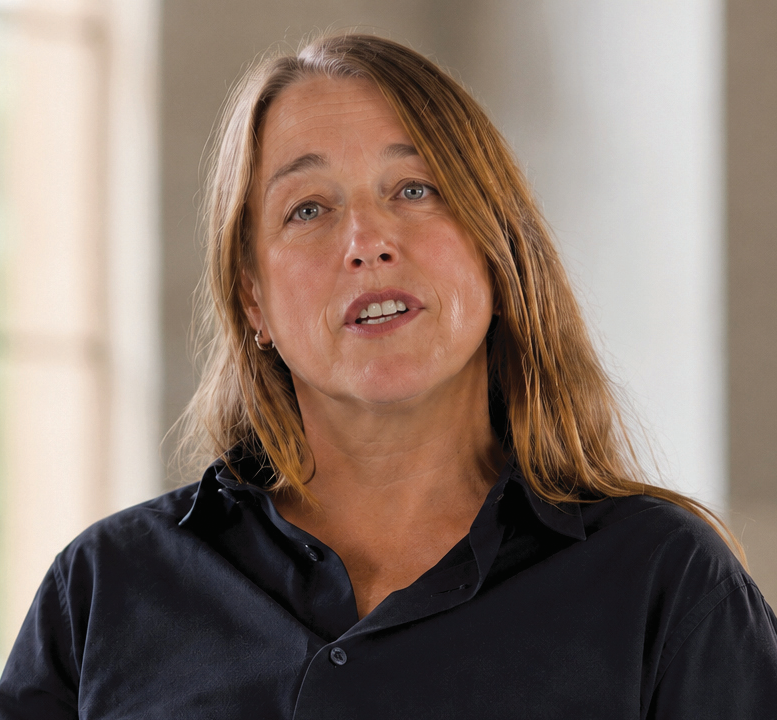
Jennifer Stahlheber

Kristin Souers

Alix Gallagher